An article named “Cutting greenhouse gas emissions through circular economy actions in the buildings sector” was published by European Environment Agency on 9th of July.
The key messages of the article are:
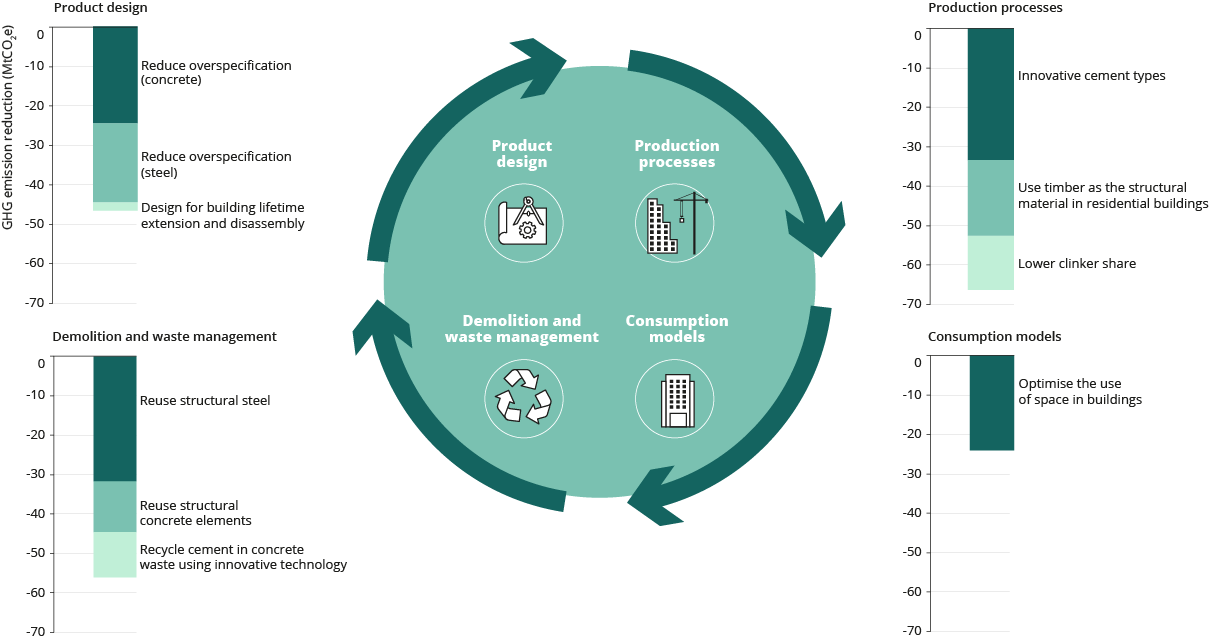
The article is based on a study conducted by Ramboll. The results of the study are shown in Figure 1. The figure demonstrates that all four phases of a building’s life cycle offer opportunities for substantially reducing emissions. The greatest potential is in the design, production and demolition and waste management phases, which also reflects these phases’ heavy influence on material flows.
Most of the shortlisted circular economy actions are promising as pathways towards reducing emissions in the next 30 years. However, three offer the greatest reductions compared with the baseline:
These three actions focus directly on making the flows of steel, cement and concrete more efficient, as these constitute some of the most emission-intensive materials used in the buildings sector. This emission intensity applies to the design phase, where overspecification drives up the use of greenhouse gas-intensive materials without a concomitant increase in quality. It also applies to the construction and waste management and demolition phases, where choices in the handling and possible reuse of these materials can have a critical impact on the resulting emissions.
Circular economy actions that reduce the demand for such emission-intensive materials can therefore deliver some of the most promising emission reductions in the material flows of the buildings sector, especially within the 2050 time-frame of this study. This makes these types of actions ideal for inclusion in roadmaps towards major emission reductions by 2030 and climate neutrality by 2050.
https://ramboll.com/media/environ/decarbonisation-benefits-of-sectoral-circular-economy-actions
One of the most significant developments in the global cement industry this year is Heidelberg…
Technology developed by Concrete4Change that can make concrete a carbon sink rather than carbon producer…
The further development of CCUS pathways is a central part of HeidelbergCement’s carbon neutrality roadmap.…
EUPAVE is a not-for-profit association, with the objective of promoting all aspects of cement and…
In the last two years, many road maps regarding the cement and concrete industry have…
The Global Cement and Concrete Assocation (GCCA) 2050 Cement and Concrete Industry Roadmap for Net…